In my own experience at startups, and even now at my own consultancy, hiring interns has been one of the best ways to build a lean team. Here are five places to find standout talent, beyond the usual job board.

In my own experience at startups, and even now at my own consultancy, I have brought interns onto my team for a number of years now. It was not always easy, since managing and training someone still finding their feet takes real time on a lean team. But done properly, hiring an intern is a genuine win win: your team gets extra capacity and a fresh perspective on work you do not have the bandwidth for, and your intern gets real world experience no classroom can offer.
Many of the startup and small business owners I speak with are stretched thin across operations and marketing, which is exactly why I still recommend hiring interns to founders. This is the first in a series of articles I am publishing on hiring and working with interns.
Post a generic ad on a job board and you will get volume, not standout talent. The switched on, ambitious ones tend to be found elsewhere. If you are a founder in the early days, working with lean resources and trying to hack your growth without the budget for full time hires, here are five places I have used to find standout interns, none of them a job board, along with what you need to know to make the arrangement work for both sides.
Universities are the most obvious hiring channel for exceptional interns, and it does not involve a job board at all. Capstone projects in particular are a great way in, since students are looking for a real business problem to solve and supervisors are actively looking for host companies.
If you are alumni of a university, offering to mentor current students is another strong path to stay connected with them. A student willing to take on a mentoring program on top of an already busy schedule already tells you something good about them, which is part of why I like this channel. I have mentored business students at UNSW for over eight years, and it has occasionally opened the door to great talent, both for specific projects and through the wider student network that spreads the word when I am hiring.
One thing worth noting is that Australian capstone and work integrated learning placements tend to run under three months in my experience. Plan for that by scoping a short, well defined project your intern can add value to quickly, and be ready to retrain a new intern each cohort if you want to continue having them in your team.
Many founders only look close to home, but internship culture is far stronger in some regions than others. Students in the United States and across Europe are used to doing internships, and a cross border placement is often the experience they want most.
If you are an ANZ startup, that works in your favour. Opening your search beyond your own geography gives you access to strong, motivated candidates and a much larger pool to choose from.
To source these interns, I have approached universities directly and worked with agencies that partner with overseas institutions, bringing me interns from Europe as well as the United States. These placements tend to run at least six months, which is great if you want someone around for longer.
Intern recruitment companies exist to take the administrative load off your plate, covering things like visas and compliance depending on where your intern is based. For a small team, time is your scarcest resource, so working with a specialist to manage the paperwork often pays for itself.
Skip the job boards altogether and look to startup networks, Slack channels and Facebook groups, which are full of ambitious students and early career professionals you will not find on a generic listing. Ecosystems like Startmate and Airtree run student programs, so their communities are already full of switched on students who understand what it is like to work in a fast moving, resource constrained environment, making for a better cultural fit from day one.
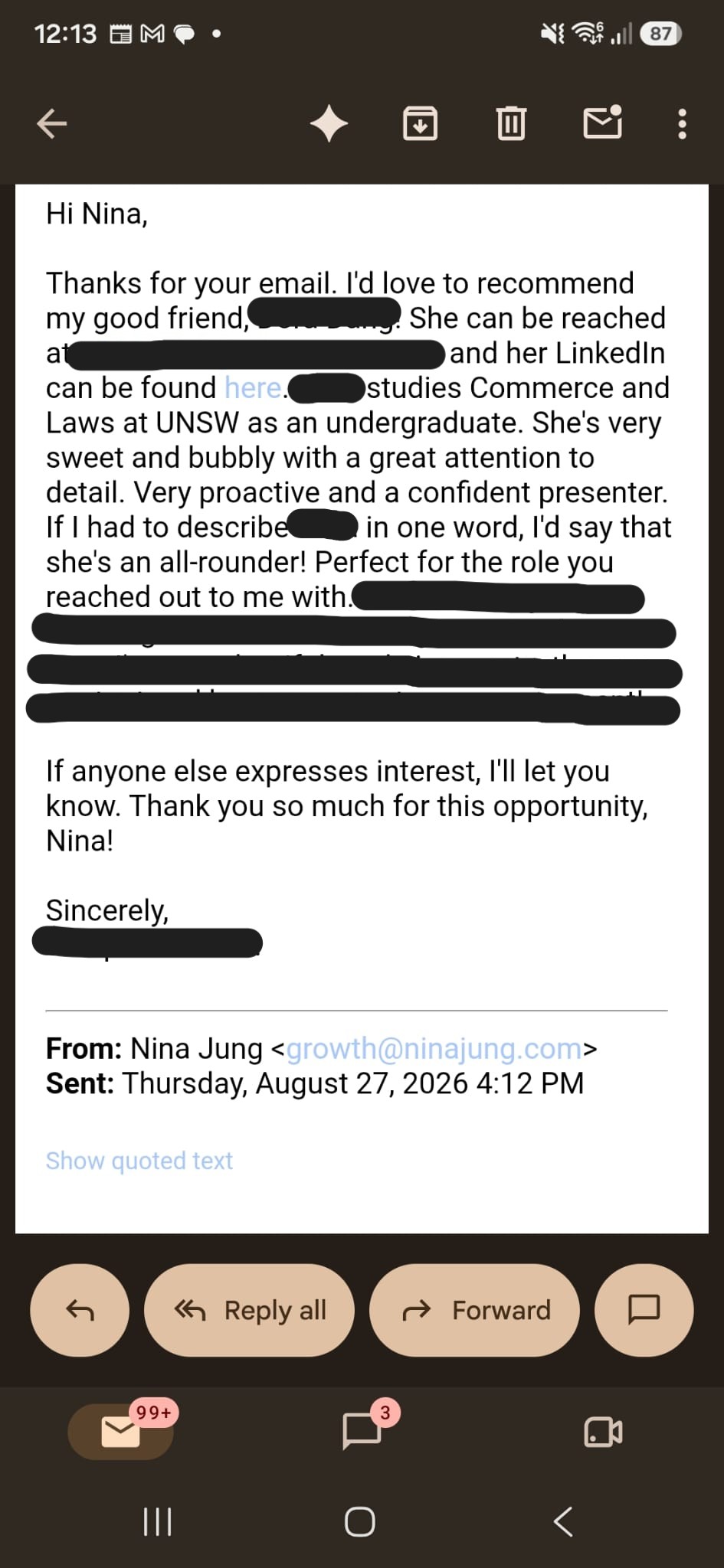
Your first strong intern is often your best recruiting asset. They know who else in their course or friend group is switched on, and a referral from someone they trust tends to outperform a stack of resumes. In fact, some of my best interns have come through referrals from other students, since the person referring them understood the role and pointed me toward the right person.
Whether the role should be paid depends on where you and your intern are based, and whether the internship is part of their course, so check local employment law rather than assume what worked elsewhere applies.
In Australia at least, the law is strict on what an intern can do in unpaid work. The Fair Work Ombudsman is clear that interns should not be filling the ongoing duties of a full time or part time role. What worked well is to structure the placement around a defined project or genuine learning experience rather than a run of mindless work like data entry. Put the same care into the job description as you would for a full time hire, so both of you start with clear expectations.
If tied to a university program, check early what is required of you as the employer. It is usually light, such as a short check in or a brief report, but worth knowing upfront.
Some of the interns I hired ten years ago are now heading up teams and running large projects of their own, and it makes me genuinely proud to have played a small part in starting their careers and giving them a competitive edge.
Bringing interns onto your team takes patience, especially early on with little to no hiring budget, when training eats into hours you do not have to spare. But it is worth the commitment. Once you find someone switched on and willing to take ownership, you have found yourself a rough diamond, and the fresh ideas and lightened load outweigh the effort. In fact, several of my own super star interns have gone on to a paid internship or full time role with me, effectively short cutting the hiring process altogether.
Next up in this series is how to interview and onboard interns for success.
Main image by Annie Spratt on Unsplash

Nina Jung is a Sydney-based growth strategist who works with founders as a fractional CMO and CRO, bringing senior-level strategy and hands-on execution at a fraction of the cost of a full-time hire. She also mentors early-stage founders and business students through GrowthMentor, Startmate, and UNSW.
